

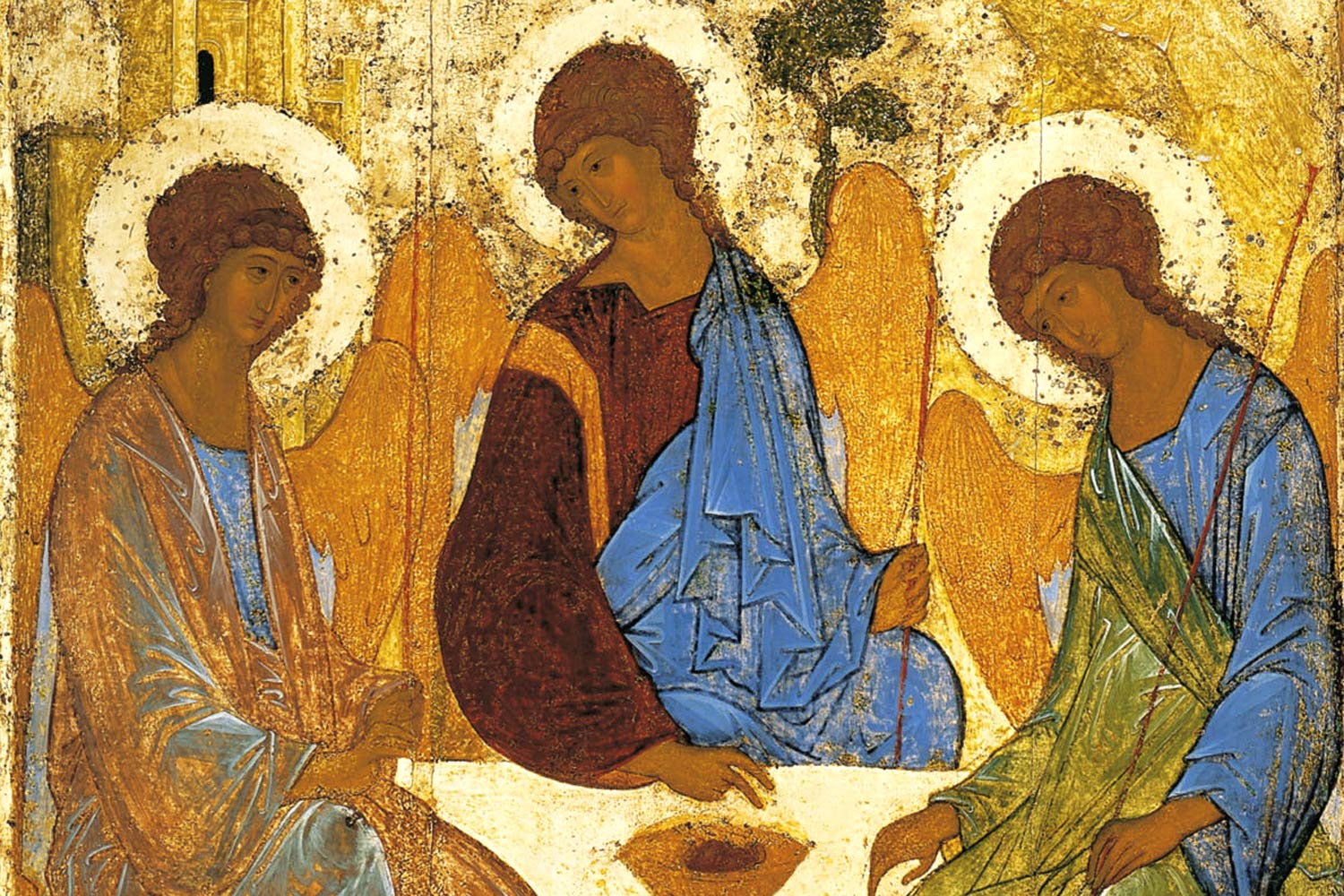
One of the most wonderful things I find in this naming of God as Father, Son, and Holy Spirit is its affirmation that there is an intrinsic plurality to good ness. Just hold on to that, all right?
Good ness isn’t sameness. Goodness, to be goodness, needs contrast and tension, not perfect uniformity. If Father, Son, and Holy Spirit are all God yet clearly different, and we embrace this differentiation, resisting the temptation to blend them into some kind of amorphous blob, then there are at least three shapes to pure goodness. (And of course, probably more.)
God’s goal, it seems to me, is the same in creation. It is the making of persons, not the making of a uniform mob, which means there is clear diversity and a kind of what I’m going to call open-endedness in all of nature, and to the very nature of this creation. In other words, heaven is precisely not uniformity. Because we did not honor Trinity, many Christians were totally unprepared for any notion of evolution – again forcing many would-be believers into quite sincere atheism.
The diversity of heaven was never something I considered in my earlier years. I thought we were all handed the same white robe and standard-issue harp, assigned to an identical cloud for all eternity.
But how does Jesus deconstruct this big-box, strip-mall, McHeaven franchise? He tells us: “In my Father’s house are many mansions.” (See John 14:2)
What a contrast! Even in the eternal nature of things, you’re somehow youin your you-ness, on the path that God is leading youon, the journey youare going through, the burdens that youare bearing. All of these are combining to create the precise alchemy of yoursoul, yourholiness, and yourresponse. In the eternal scheme of things, we discover that all God wants from you is you.
It’s just so humbling, because it always feels like not enough, doesn’t it?
“All I want to do is to be like Saint Francis,” I said to my spiritual director, over and over, for my first decade as a Franciscan.
Finally, one day, he said, “Hey Richard, you’re not, and you’re never going to be, Francis of Assisi. You’re not even close, all right? You’re ‘unfortunately’ Richard Rohr from Kansas.” I said to myself, This doesn’t sound nearly as dramatic or exciting.
Exceptwhen I realized: all God wants is Richard from Kansas.
But that’s what I don’t know how to give you, God!
It feels so insignificant, and yet this is the liberating secret: I am precisely the gift God wants – in full and humble surrender. There is unit between the path taken and the destination where we finally arrive. Saints are not uniform but are each unique creations of grace according to the journey God has led them through.
This is God’s great risk of freedom: allowing us the freedom to do our own thing. The scandal of grace is that God will even defer – talk about self-emptying! – to using these mistaken dead ends in our favor. This is the ultimate turnaround of love: each of us is our own beauty, a freely-created, grace-sculpted beauty – what poets and dramatists often name tragic beauty.
Culled from Richard Rohr, The Divine Dance(London: SPCK, 2016), 61-62.

 Alongside One Another