


It is exactly 50 years since the end of the Nigerian-Biafran War (1967-1970). The war ended on Thursday, 15 January 1970. It was a terrible war, the effect of which has continued to reverberate in Nigeria today. Part of the tragedy of the war is the inter-generational trauma that it has created. Secessionist movements like MASSOB and IPOB, are instances of the effect of this trauma. But the trauma is not sustained by a mere fantasy to ‘recreate’ Biafra, rather it is fanned by the continued perception of marginalization of the former Eastern Region as well as the absence of the process of memorialization. Memorialization process through education, history, erection of monuments and museums, commemoration of the event and victims, would have helped to heal the trauma of the war over the years. Yet, Nigeria has continued to live in self-denial of what had happened, discussions concerning the war are hushed, and literary works that address the event(s) are completely forbidden. There seems to be an official paranoia in Nigeria over Biafra. The haunting ghosts must be real. It is the fear that had stalled every form of national conversation and learning over the years, punished unyielding voices, proscribed neo-Biafrans in a rather frenetic pace, and kept the embers of the war very much alive. Nigerian leaders must realize that there is no alternative to dialogue. We need to build a robust culture of dialogue in addressing communal life, governance, history and our future. The rule-by-command mentality, which is a side-effect of the military junta, must give way to civil conversation, mature discourses and even legitimate dissent. Biafra beckons us to the dialogue table. It holds out the promise of a new dawn, not just for Nigeria but for the entire Black Africa. It is either we embrace this our history, this our collective narrative, or the ghost will continue to haunt us.
For the past few days, there have been some discussions in the media concerning the Nigeria-Biafra war, sometimes with an appreciable level of honesty, and sometimes with unbalanced narratives. For instance, to put out a clip of Gowon’s interview without showing part of late Ojukwu’s exclusive interview on the subject matter is an unbalanced reportage. Both ‘main actors’ must be given a voice, even if from the land of the dead. If the accounts of Ojukwu and Gowon about the last effort to save Nigeria from war was based on the failure of the ‘Aburi Accord’, then one is compelled to ask: Where are the records of Aburi? What is the content of ‘Aburi accord’? Can we make our own interpretations of the said accord?
In contributing to the discourse, however, we bring to you an account of what happened at the World Council of Churches (WCC) Assembly, at Uppsala in 1968, in the heat of the war. There is no analysis of the report. The idea is to present a report of how the war played out at different theaters around the world, one of which was Uppsala, a small city near Stockholm in Sweden, the time between Akanu Ibiam (on the Biafra side) and Bola Ige (on the Nigerian side). Enjoy!
Political neutrality: The case of “Biafra”
Alongside the three main issues of the assembly – the relationship with the Roman Catholic Church, the problem of development, and the issue of racism – the assembly also dealt with various political conflicts, adopting statements about particular situations. However, neither the “Resolution on Vietnam” – adopted by the assembly with 20 votes against and 30 abstentions, not the appeal to the US to stop the bombing of North Vietnam and for the restoration of peace, nor the “Resolution on the Middle East,” in which delegates expressed concern about the tense political situation there, made a lasting impact in the media. It was rather the political conflict in Nigeria that received most attention in public media, at least in German-language newspapers, possibly because of the demand of the German delegation for a statement on the Biafra conflict, where there was a need not only for “charitable action but also a political solution to the conflict in Nigeria/Biafra.” (*The conflict was triggered by the declaration of independence of the oil-rich eastern Nigeria region of the rest of the country on 30 May 1967. The Nigerian government did not recognize the “Republic of Biafra” and sent the army to the eastern region on 6 July 1967, leading to a bloody civil war in which more than a million people died until the reintegration of the eastern region into the Nigerian state in January 1970.)
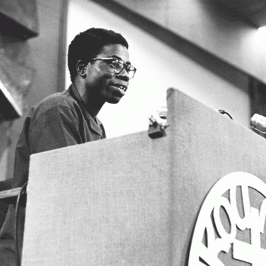
The WCC’s Inter-Church Aid, Refugee and World Service, in cooperation with other aid agencies, had already provided significant financial and material resources since the onset of the crisis, as well as urging member churches to assist local churches there. A controversy broke out at the assembly, however, whether such emergency assistance also included taking sides politically. Two of the representatives from the region at the assembly and former student friends – the Nigerian lawyer and human rights activist Bola Ige and the former governor of East Nigeria/Biafra, Akanu Ibiam, an ongoing WCC president – tried to convince the delegates of their own position. *(On Akanu Ibiam, see Modupe Oduyoye, “Akanu Ibiam,” 108-111 in Ion Bria and Dagmar Heller, eds., Ecumenical Pilgrims: Profiles of Pioneers in Christian Reconciliation (Geneva: WCC Publications, 1995)* While Ibiam campaigned for the recognition of Biafra and attempted to make the assembly aware of the scale of the humanitarian catastrophe, Ige made it abundantly clear to the assembly that the Nigerian Christian Council would not tolerate the name “Biafra” being used in a statement by the WCC.
The assembly tried to do justice to both sides by issuing two statements: the first was a “Statement on Relief,” underlying the need to “establish a continuous and effective airlift” to allow the distribution of humanitarian aid. The second was a political statement on the “Conflict between Nigeria and the former Eastern Region,” which stressed that the WCC did not wish to and was not able to take sides, and thus would not use the name “Biafra.” The statement urged both sides to end hostilities, to resume negotiations, and to work for peace and reconciliation. Nevertheless, it was a difficult task for the WCC until the end of the civil war to maintain a genuinely neutral position and to defend this against both sides.

The account is taken from: Annegreth Schilling, “The Ecumenical Movement and 1968: The Uppsala Assembly as the Beginning of a New Era?” The Ecumenical Review 70, no.2 (2018): 194-215; 210-211.
Dialogue! Dialogue!! Dialogue!!!

 Alongside One Another