

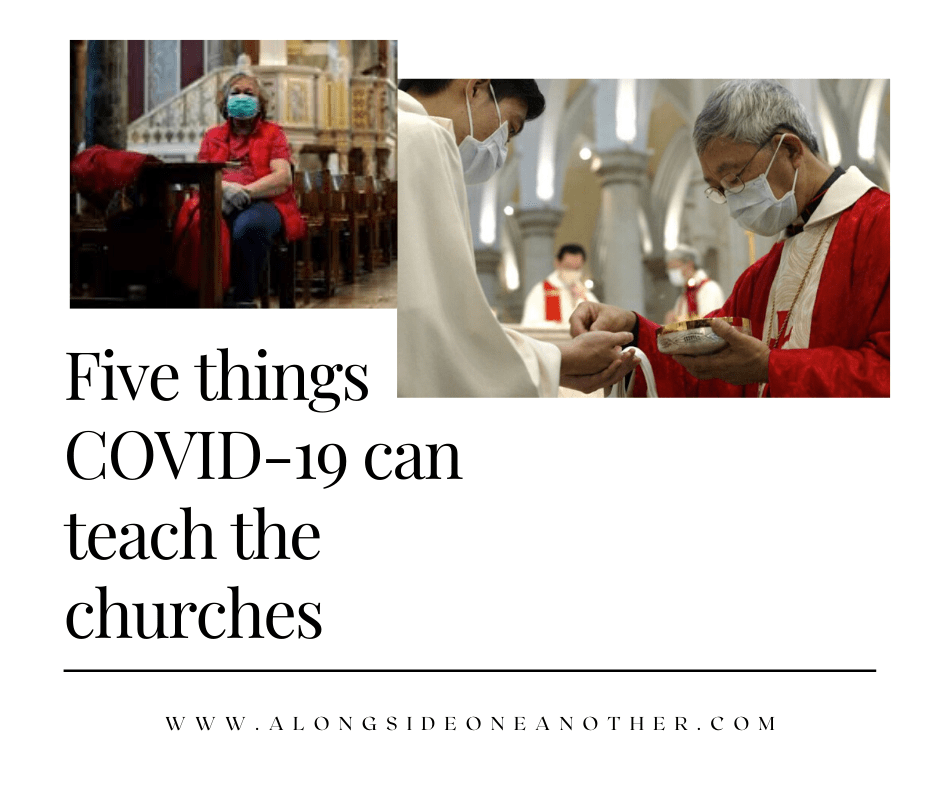
In response to the pandemic, there have been many write-ups concerning the appropriate precautions to be taken, the activities to be explored during lockdowns, ways to take care of the body and mind, as well as the existential lessons that we ought to learn from the COVID-19 experience. In an earlier post on this site, I explored how the pandemic has succeeded in exposing our collective vulnerability, not only in the fragility of life, the illusion of what we had thought we can control and the grave inherent depravity that we never knew was there all along. In that piece, I also called for solidarity, which is a Gospel value that is much needed at a time like this (cf. https://alongsideoneanother.wordpress.com/2020/03/18/coronavirus-and-our-naked-humanity/). Still, in line with the reflections on this global crisis, one asks: What lessons has the Christian community learnt? Or rather, what is COVID-19 teaching churches today? I wish to point out five of these lessons:
1) God is still in-charge of the world that God created – The near-collapse of everything during this pandemic has exposed how feeble, vulnerable and unreliable all human-built systems and institutions are. Governments are scampering for response and solutions, with many finding it difficult to provide clear leadership. Economies are on the decline. For those who had worshipped money and wealth before now, the only concern is to survive the crisis. Churches are also not spared. The pandemic has shown us how the church is not about structures and self-acclaimed prophets, but about God in communion with the community of believers, united in hearts and minds, not necessarily and always under the domes and temples. Churches can now return to how to focus their attention on God and not to structures, personalities, fading glories, and even wealth. Church leaders should exercise humility and accept their place in the grand scheme of things. This is a call to an absolute trust in God.
2) A re-learning of the virtue of mercy and compassion – The pandemic has once again brought to the fore the ministry of mercy and compassion in the Church: “Be merciful as your heavenly father is merciful” (Luke 6:36). Pope Francis has constantly reminded us that ‘the name of God is mercy’ as if to prepare our minds to what God expects of us as the Christian community towards humanity: “Mercy is the very foundation of the Church’s life. All of her pastoral activity should be caught up in the tenderness she makes present to believers; nothing in her preaching and in her witness to the world can be lacking in mercy. The Church’s very credibility is seen in how she shows merciful and compassionate love.” (Misericordiae Vultus, no.10) In a good way, many churches responded and have continued to respond appropriately to this call by a range of diaconal services – offering spaces for the isolation of victims, opening up food banks, giving out palliatives, offering spiritual companionship to people, and consolation to families who lost loved ones. May this lesson on mercy and compassion continue, and be deepened, even in the post-COVID era.
3) Faith is not opposed to science and reason – Churches are becoming more conscious of the fact that faith is not opposed to science and reason. This is not a new teaching, even though it seems to have been thrown aside by many Christian communities that have given up on this world and preach a one-sided salvation that focuses exclusively on getting to heaven. History shows how the Church has contributed immensely to science and knowledge, and continues to do so. Indeed, “the Church cannot but set great value upon reason’s drive to attain goals which render people’s lives ever more worthy.” (John Paul II’s Fides et Ratio, no. 5) Attempts by some Christian leaders to either dismiss the pandemic or trump up unsubstantiated theories around the virus are quite unreasonable. Reason is at the service of faith. Faith does not have all the answers, even when it “is the assurance of things hoped for” (Heb.11:1). Only God does. And God is the creator of reason as well. Human beings should make use of reason for the good of all. These are lessons churches are learning the more.
4) Social well-being is part and parcel of the salvific mission of the church – This is different from the prosperity Gospel that downplays the cross of Christ and trivializes the Gospel message of salvation. Churches should learn that the Christian mission includes the struggle for social justice, struggle against poverty, hunger, corruption, conflict and anything that truncates abundant life for all (cf. John 10:10). In a country like Nigeria where churches hardly challenge the political structures that perpetuate corruption in a radical way, we have seen how rotten the healthcare system is and how brazen poverty rears its ugly head in our communities. It is not enough for churches to build their own hospitals and schools, which sometimes are not accessible to the poor. Churches should begin to mobilize against social injustice in all its forms for the benefit of everyone. This is the way to transform the society rather than creating pockets of utopias here and there.
5) Solidarity as an opportunity for ecumenical collaboration – The level of solidarity that the pandemic teaches us is a great chance for churches to forge greater ecumenical collaboration, partnership and relations. Imagine a situation where the different churches forget some of their differences in order to witness to the Gospel of mercy, compassion and social justice. I am pretty sure that many people who benefitted from the palliatives from churches did not care if they got it from the Catholic or Anglican or Methodist or Pentecostal or Presbyterian church. When humanity faces a common crisis, the response becomes a trans- and con-denominational affair. But we are in daily crisis, particularly in Africa, as a result of bad political leadership. Can churches come together to provide ‘political palliative’ as well? Imagine where the churches ‘stand in the gap’ to prevent politicians from exploiting the masses during electoral seasons with a message that is based on electing competent people. Imagine where the churches converge to insist that the best leadership for the people is a non-negotiable.
COVID-19, I believe, offers these lessons to the churches, individually and collectively. It is an opportunity to re-imagine a better world, where the Christian mission will remain actively relevant in bringing about the power of radical transformation that the Gospel of Christ bears.

 Alongside One Another
Nice one Padre!
LikeLike
Thanks for reading Oma. God bless!
LikeLike
Great insights, indeed! We all bear our vulnerability with us in everything, at every moment, and in every place. This chaotic period is an opportune moment for all – everyone of us to learn not only with our mental capacities, but also with the ‘eyes’ of our hearts.
Thank you for your thoughts, Dr. Paschal!
LikeLike
Thank you Isaac for your kind comments.
LikeLike
Honestly, things will change if Lesson 3 and 4 can be applied in Nigeria. The church needs to stand up against all forms of political manipulation in Nigeria.
LikeLike
Thanks for the comment, Chidinma. We keep working and praying towards that.
LikeLike
No 3 is really true but the so called pastors whose concentrations are to enrich there pocket will not tell members.fr thank you for this more grace I pray.
LikeLike
Thank you Adaugo for you comment. The 5 issues remains a lesson for all of us, for we are the church. God bless you.
LikeLike
Paschal,
It’s deeply thought and aptly articulated in line with our Faith and Tradition!
It’s cosmo-Theo-andric reflection!
LikeLike
Thanks a lot Raphael. In a time like this, we are called to greater leadership, in humility and service to humanity.
LikeLike
Thanks Fr., for being generous with these thought which when lived out, can only make our co-existence better. Thanks once more dear Fr.
LikeLike
Thanks a lot my brother.
LikeLike