

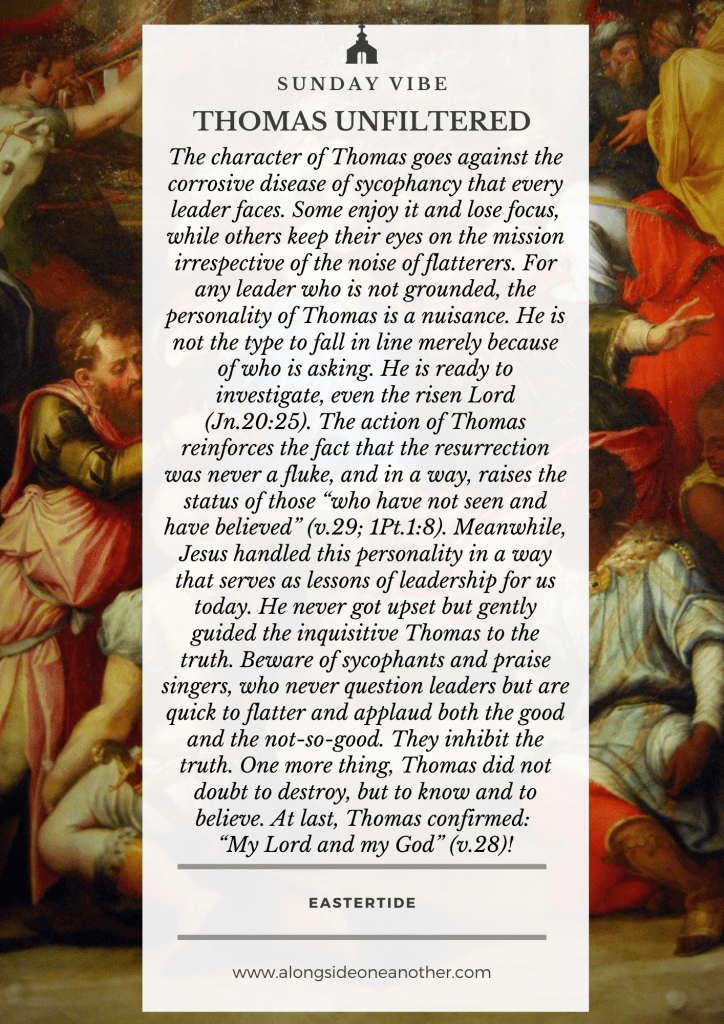
There is something quietly courageous about Thomas. While the others had already seen the risen Lord, Thomas refused to perform a faith he did not yet possess. He would not pretend. In a room full of rejoicing, that takes a certain kind of integrity.
Jesus does not punish him for it. He shows up again, specifically for Thomas, and offers his wounds as evidence. Not a rebuke, but an invitation: “Put your finger here” (Jn. 20:27). Here, the risen Christ meets honest doubt with patient, tangible grace.
This is the logic of the early Church too. In Acts, signs and wonders multiplied not through blind enthusiasm, but through a community tested by hardship and growing in credibility. The early Church was a community of devotion that flowed from “sincerity of heart” (Acts 2: 42-47)
Faith that has wrestled with doubt carries a particular weight. We see this in the stories of converts, whose believing has conquered the force of unbelief and doubts. Today, Thomas’s confession, “My Lord and my God”, remains arguably the most profound Christological statement in the Gospel, precisely because it cost him something.
We pray for the gift of honest questions for blessed are those who question honestly, and still arrive at love.

 Alongside One Another